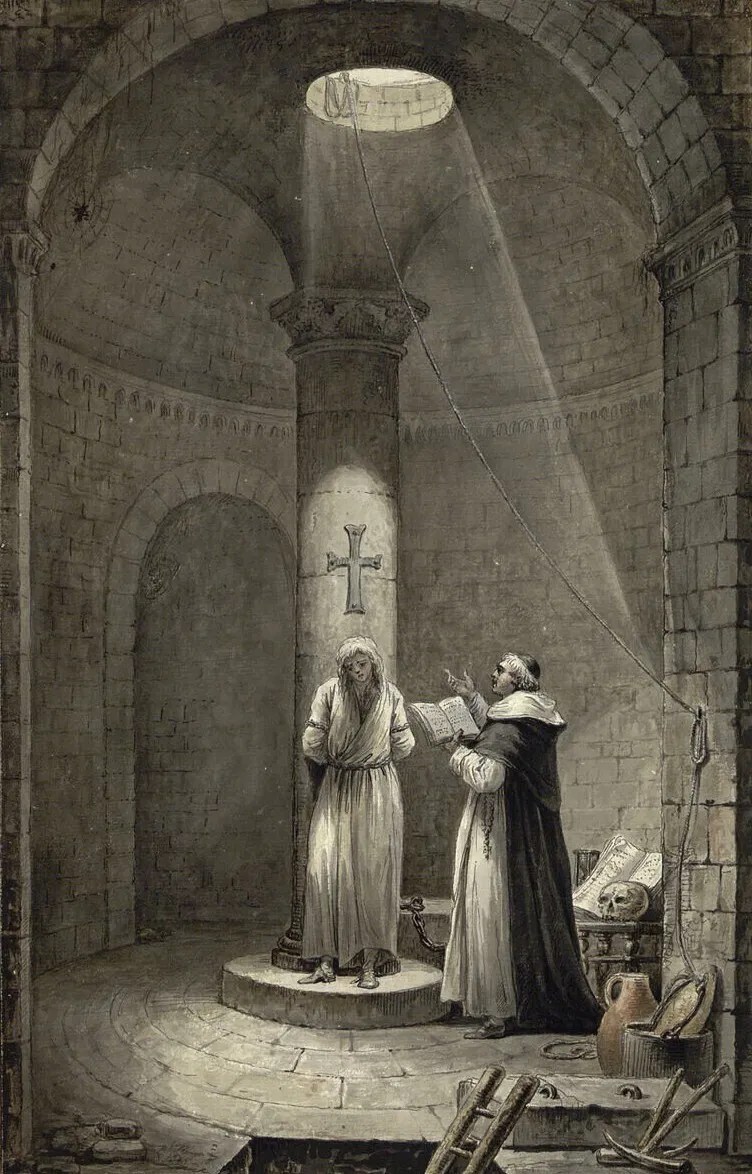
Source of image: A prisoner of the Inquisition in this imagined scene by Jean Louis Desprez, c. 1789. Albertina. History Today https://www.historytoday.com/archive/history-matters/behind-closed-doors-women-and-inquisition
Let’s imagine a person is dead in your neighbourhood. Their family member accuses you, the next-door neighbor, as the killer. The next few days, both of you appear at the trial. Of course, the intention of the other side is to convince the Court that you must be the killer because of, for example, the proximity. The intention of you, apparently, is to convince the Court that you did not do anything to the deceased victim. As you may notice, the intention of both sides is clear, which is to defend their own interests and protect their beliefs. The Court, staying in the middle, now has to do one task:
Who’s telling the truth? What is the truth?
Which evidence that is presented could be trusted?
The model of justice throughout human history has long sought the answer to this. If you still remember my previous blog #1 Criminal Justice: Who I am messing with, you may remember the private nature of early corrective justice. Because the ancient criminal law was the law of wrongs, or the law of torts, the early courts in the Western Europe to try criminal cases is no different from a ‘civil procedure’. [1] When the form of private revenge was no longer practiced, the post-primitive society had an open court with the ‘confrontation between equal parties’,[2] the plaintiff and the accused, before an impartial judge. The initiation of the criminal proceeding also must start from a complainant. This was captured in the German proverb ‘Wo kein Kläger, da kein Richter’ (Where there is no plaintiff, there is no judge), emphasizing that if the case was not brought before Court by the injured party, there would be no criminal court.
The above demonstrated the early form of adversarial justice model, which was later developed in English common law. The criminal court in countries following adversarial models view the trial more of ‘a contest or a dispute’, with the participation of two equal ‘adversaries’ before an independent and fair judge who would reach a verdict after hearing two versions of truth from each side.[3] The role of the judge could be compared to a referee in a football match, ensuring the court procedures and procedural safeguards are upheld. Both parties are given the right to ‘conduct their own investigation’.[4] The pro-adversarial-model believes that they shall achieve fairness by giving the equal right for both contesting parties to present their own case and argue for themselves.[5]
Now let’s turn to the inquisitorial justice model. This model started in the Middle Ages, as a tool to combat ‘heretics’. If the adversarial model captures the contesting relationship between two adversaries, then the inquisitorial model also depicts the relationship between the ‘inquisitor’ and the accused. The inquisitor believed he was avenging God for the wrongs inflicted on God by the offender for misbelief. Different from the previous era, the public authorities could initiate a criminal proceeding, not just private complainants.[6] The trial could be described as the tension between the accused and the judge. The judge held the power to investigate the case and interrogate the accused. ‘The whole procedure was conducted in secret. One of the main purposes of the inquiry was to obtain confessions from the accused, even by torture, if necessary.’[7]
The inquisitorial model was later developed and refined (for example rights of the accused were added). Central to this model was the belief that letting the subjective parties to lead the cases, presenting whatever benefitted only their side, could not achieve the complete picture of the truth. Rather, the case should be led from the beginning with an impartial, independent authority. The role of the parties is more passive and secondary in the Court. After the legal reform in German and French, new changes were added to the inquisitorial criminal model. The main goal is to decentralise the power of the judge so as to prevent arbitrariness and malpractice. From there, there was not one single judge to rule the case, but the trial by jury was brought into place. Judges no longer have the dual role of investigation and adjudication, rather, the role of investigation is then placed upon another separate agency which is the state prosecution/ state investigative agency.[8]
References:
[1] CR Snyman, ‘The accusatorial and inquisitorial approaches to criminal procedure: Some points of comparison between the South African and continental systems’ (1975) 8(1) The Comparative and International Law Journal of Southern Africa 100, 101.
[2] Ibid.
[3] M. Damaska, The Faces of Justice and State Authority. A Comparative Approach to the Legal Process ( Yale University Press, 1986) 3.
[4] Tom Decaigny, ‘Inquisitorial and Adversarial Expert Examinations in the Case Law of the European Court of Human Rights’ (2014) 5(2) New Journal of European Criminal Law 149, 152.
[5] Ibid 153.
[6] Snyman (n 1).
[7] Ibid
[8] Ibid 102.
 Duck Learns Law